When Rodleigh, Amanda and Steph did our professional coaching diplomas at École Nationale de Cirque in Montreal, we were taught that there are four circus “streams”. That these four streams have differing pedagogical approaches according to their goals, participants and desired outcomes;
- social circus
- recreational circus
- high level/professional circus
- circus as it may be taught within a high-school curriculum
As a professional coach, you should determine which of these four approaches you are teaching from for every class you coach. To have successful outcomes, each class (approach, exercises and expectations) should be tailored to that modality. To work out which stream your class falls into you can be guided by the circus company’s ethics and mission statement as well as conferring with your manager/employer. It is worth noting that not all classes in the one company may require the same approach.
This may sound straight forward and obvious but as coaches who had transitioned from performers, we found it very useful information. It gave us terminology and language to help us set more realistic outcomes for different classes. Teaching to the required stream allows students to excel within the expected parameters. Coaches can also enjoy the students’ personal successes without necessarily always having an expectation of virtuosity or physical improvement.
However, in the past five plus years, since we completed our courses, we have seen a massive increase in local, national and international circus competitions. Similar to dance eisteddfods, these local, national and international circus competitions now offer an exciting simulation of a professional performance. However, instead of an excited audience who are keen to enjoy a live show, there are judges, trophies, prizes, winners and losers. Competitions where you can win or lose are a very different experience than a performance in front of an appreciative audience.
We have written this blog to give an overview of the different streams of circus coaching and performance as well as to argue that this new outlet of “competitive circus” needs its own pedagogical approach. Teaching to create competitors will be appropriate for some companies, some classes and some students but will not be an approach that is suitable for all companies, all classes and all students. Indeed, incorrectly applied, competitive circus coaching could do lasting psychological harm.
First let’s get into defining the pre-existing different type of circus coaching.
Social Circus
Social circus is a mode of teaching and performance that aims to create and develop inclusion and community in marginalised or disadvantaged populations. Social circus projects can include people from populations such as: neurodivergent youth or adults; “at risk” or disadvantaged youth; members of marginalised communities or third world communities, etc.
Social circus creates a fun and safe space for participants to explore creativity and self expression. At a macro level, it promotes collaboration which engenders community and inclusivity. On a more individual level, social circus develops the participants self-esteem, autonomy, and self-regulation through creative play, controlled risk taking and teamwork.
Unlike in some of the other streams of circus (eg. professional and recreational), the outcomes can be more workshop-based, focusing more on the lived experiences of the participants. While there is often a performance element, the relationships developed between the participants and the community is the real measure of the success of a social circus initiative.
There are social circus projects all over the world. For example in South Africa, there is Zip Zap Circus, a social circus project that focuses on creating positive ties between different races in post-Apartheid South Africa. In Australia, an example is Vulcana Circus, which focuses on creating a safe circus space for women, trans and non-binary members of the community. Cirque du Soleil also had its own social circus program (now defunct), called Cirque du Monde.
Recreational Circus
Recreational circus is a form of circus in which students participate for pleasure or fitness and can start at any age in their life. The vast majority of the participants do not become professional/high-level performers.
Recreational circus is becoming increasingly popular as a form of fitness and source of community. Aerial circus disciplines are in a particularly prevalent growth period; new aerial studios are opening up all over the world and existing dance and pole studios are incorporating recreational aerial circus classes into their existing programs. Ground-based circus disciplines (eg. handstands, juggling or Cyr wheel) are also increasing in popularity, with larger circus schools like Flipside, NICA and C!RCA offering programmes in a range of circus disciplines (aerial, ground, balance, manipulation) for people of all ages.
Recreational circus has many benefits; it is more exciting and engaging than attending a gym for weight training and it gives participants opportunities to develop coordination, resilience and perseverance in a fun and supportive environment. Recreational circus intersects other types of circus we will discuss in this blog. It can offer similar effects to social circus (eg. community building), however classes are expensive and are rarely accessible to marginalised communities (as are social circus projects). Recreational circus also intersects with the concept of “competitive circus,” as many recreational participants are willing to pay to attend a competition in order to access a public platform for performance.
High Performance
There are a select number of high performance circus schools across the world that offer full time high performance circus training, such as ENC, NICA, NECCA, Academie Fratellini and CNAC to name a few. Students who choose higher level training have already decided to become professional performers. These schools select a very limited number of students for their programmes (which normally last three years). The audition requirements are very strict. This helps the school select the students that have the best chance of succeeding in their program. All students need to take a primary and secondary discipline to pursue as well as dance, theatre, acrobatics and other creative disciplines. The variety of skills makes them more employable after graduation.
A student in a professional training school will be assigned qualified coaches in their disciplines. They will train for many hours over many days of the week; a similar schedule to full-time employment. Each phase of the training is done with great care to the student’s well-being but there are definite expectations that the student will achieve at the highest levels. These schools have extensive safety protocols to cater for the high technical levels that are being taught (eg. foam pits, safety lines, trained spotters). Many of these students go on to work with major companies like Cirque du Soleil, 7 Fingers, Cirque Éloize or start their own circus performing companies.
High School Circus
Circus classes in high school settings generally combine elements of recreational and social. Often the circus classes are under the umbrella of the school’s performing arts program but sometimes they can be part of the sports program or part of the school’s “after school care”. The outcomes, expectations and pedological approach will be dependent on what umbrella the circus classes fall under (social, recreational, performance).
Circus in high-school settings can help young people develop body awareness and fine motor skills and help them get fitter and stronger in a fun and creative way. It promotes confidence, teamwork and collaboration. It also teaches physical discipline and resilience. Students who participate in circus in high school also may see it as a possible career opportunity in the creative arts.
Students at high school age will start deciding if they are competitive or not. Since circus is generally a non-competitive activity it will often attract students who do not like competitive sports. Circus skill development challenges the student to improve themselves, be it by improving strength or flexibility or concentration.
Some students will gravitate towards manipulation disciplines like hula hooping, juggling or diabolo. Other students may choose balancing disciplines like rolla bolla or globe walking, tight wire walking or slack wire. Aerials and acrobatics are very fun and exciting disciplines for high school students to participate in. Clowning intersects beautifully with physical theatre and can be a great outlet for young people to enjoy. Circus is such a generous artform, it truly has a place for everyone to thrive.
A high school circus program may be a regular program offered by the high school or it could take the form of a workshop provided by an external organisation. It is important for the trainers and teachers to have a good knowledge of social circus methodology and pedagogical approaches so that they can empower young people and enrich their lives.
Competitive Circus
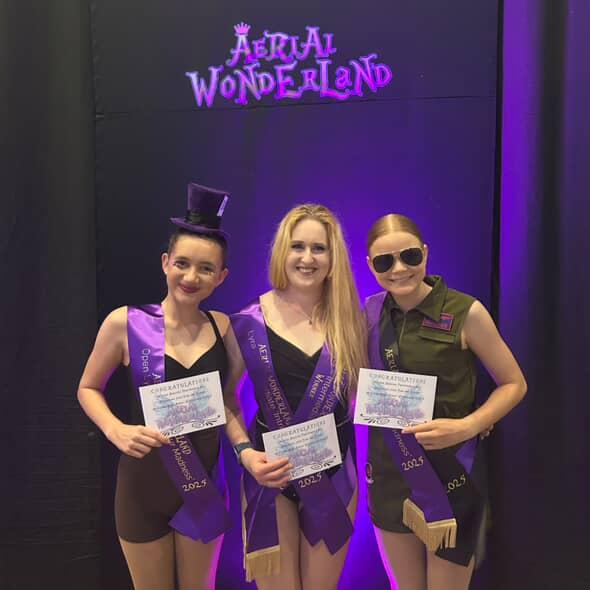
Our argument here is that competitive circus is a new stream of circus with its own set coaching/training and outcomes. Competitions have gained in popularity with the boom in the recreational circus industry. Circus competitions, such as Aerial Wonderland, Bend the Air, La Folie, Mx Lyra, Eclipse Aerial Championships, in Australia offer anyone the opportunity to perform a routine in a theatrical setting with lighting effects, in front of an “audience” and with other professional trappings (sound, costume, staging). The heats are generally grouped within an age range and apparatus type and the performers are judged against a known set of criteria. Each competitor pays a fee to compete and there are publicized winners (and therefore also unpublicised “losers”). The competition is generally a commercial venture for the operating company.
Performing competitively, can have both positive and negative impacts for a participant. It allows a student to gain access to a professional setting and an audience, which can improve their self confidence. It is an opportunity to have professional photos and videos taken (access to which is generally controlled by the operating company and requires additional payments). “Losing,” however, can have very negative effects on a participant’s mental health and self esteem. This is important for coaches to be aware of when encouraging participation in a circus competition. A student should only consider entering a competition if they are emotionally resilient. The student’s coach should have a good idea of whether the student is an appropriate applicant and should be consulted in the process.
From an industry perspective, a competitive circus circuit provides great opportunities for economic growth and financial sustainability. Studios and coaches benefit financially from the increase in performing outcomes because it encourages students to book and attend more classes to perfect their performance. Studios also benefit from the publicity of competition performances; it is an opportunity to advertise their coaches and expertise to their target demographic. Non-dominant sectors that intersect with circuses also benefit, for example costume-makers benefit from the increased need for performance-specific outfits. Manufacturers, such as Trix Circus, benefit from an increased need for participants to control their outcomes by purchasing and using their own equipment for the competitions.
In Conclusion
Many schools and studios operate under multiple approaches. For example, Flipside Circus has an artistic pre-professional/professional program as well as having recreational circus classes, teaching high-school circus classes and also having a social circus program. Flipside don’t teach in, or focus on, the competitive circus arena. As mentioned earlier, as a coach, it is important to consider the school’s ethics/mission statement and to plan your coaching and your student outcomes with these in mind. When coaching a student for competitions, as a coach you need to first consider the resilience of the student and create a considered approach that readies them both physically, technically and psychologically for a competition environment. Competitions can be a great way for a student to show their art and to feel alive on stage, they just require a considered pedagogical approach.